
Is the new EU Declaration of Conformity template 2027 just the old EC Declaration of Conformity with a new regulation number pasted in? That will be one of the most expensive mistakes after Regulation (EU) 2023/1230 starts to apply. Someone will open an old Word file. Replace Directive 2006/42/EC with Regulation (EU) 2023/1230. Change EC Declaration of Conformity to EU Declaration of Conformity. Add a fresh date. Leave the standards copied from the previous machine. Done? No. That document may look neat, but it will survive only until the first technical question.
The common 2027 mistake: old EC Declaration + new Regulation (EU) 2023/1230 + the same recycled standards list = a document that looks good until the first technical question.
The biggest change is not the switch from EC to EU. The new declaration has to show that the manufacturer can prove conformity, not merely repeat a legal sentence. That is why the fields in the declaration are not harmless form boxes. They are a map of technical responsibility.
EU Declaration of Conformity template 2027: the first trap
The first question is simple: who takes responsibility?
Not in a vague commercial sense. Not because the machine carries CE marking. The declaration must state clearly that it is issued under the sole responsibility of the manufacturer. That sentence is not decoration. It means the signature closes a real process: risk assessment, technical documentation, selection of applicable requirements, conformity assessment procedure and the decision to place the machine on the market or put it into service.
The second question is just as blunt: which conformity assessment procedure was used?
It is not enough to write that the machine complies. The manufacturer must know whether conformity was demonstrated by internal production control, EU type-examination followed by conformity to type, full quality assurance, or unit verification. For machinery and related products listed in Annex I of the Machinery Regulation, that choice is not a casual administrative preference. It can change the whole route to compliance.
The third question is where many documents start to crack: what is the basis for presumption of conformity?
Harmonised standards are not ornaments. If the manufacturer relies on them, they must be identified and used with intent. A copied list of standards from the last project is not evidence. If a standard was applied only in part, the manufacturer must understand exactly which essential requirements it covers and which remain outside that presumption of conformity.
The manufacturer’s signature means: risk assessment → technical documentation → standards → conformity assessment procedure → EU Declaration of Conformity. The declaration does not start the CE process. It closes it.
What the EU Declaration of Conformity template 2027 must actually show
The declaration does not need to be long. It needs to be hard to detach from reality.
A good EU Declaration of Conformity connects several things that too often live in separate folders: machine identification, manufacturer data, legal basis, harmonised standards, common specifications where relevant, conformity assessment procedure and responsibility for the signature. If those elements do not fit together, the declaration starts to fail as a document.
You can have a clean PDF. You can have a signature. You can have an impressive standards list. But if the technical documentation does not explain why those standards were used, why that procedure was selected and what machine the declaration actually covers, the problem is not the layout. The problem is that the declaration pretends to be a process that cannot be defended later.
Sole responsibility of the manufacturer is not boilerplate
Some people will read that sentence too fast: the declaration is issued under the sole responsibility of the manufacturer.
That does not mean the manufacturer had no responsibility under Directive 2006/42/EC. Of course they did. But under the new format, the responsibility is made much more explicit. The document is not just saying: the machine meets the requirements. It is saying: the manufacturer stands behind that statement.
And if the manufacturer stands behind it, there must be something to stand on: a real risk assessment, complete technical documentation, the correct conformity assessment procedure, properly selected standards and a clear identification of the machine.
Without that, the sentence on sole responsibility becomes just another line in a PDF. It looks good until a customer, inspector, notified body, market surveillance authority or lawyer asks the first detailed question.
Harmonised standards: a number is not an alibi
Do not list standards the way you list references at the end of a university paper. The declaration is not trying to look academic. It is answering a technical question: on what basis do you claim that this machine meets the relevant essential requirements?
You list ISO 12100? Good. Now show the risk assessment.
Not a table with five hazards. Not a colourful matrix. Not a generic statement that the risk is acceptable. Show the machine limits. Show life phases. Show changeover, cleaning, clearing jams, maintenance, setting, servicing, foreseeable operator errors and reasonably foreseeable misuse. Show the protective measures selected and the residual risks left after those measures.
ISO 12100 is not a standard for making a pretty table. It is the logic of the whole risk reduction process.
And what about the instructions for use? Writing that the risk assessment was performed according to ISO 12100 does not automatically prove that the manual is usable, structured and clear. If the manufacturer wants to show that the instructions were prepared as a proper user document, ISO 20607 is the natural companion. ISO 12100 drives the risk assessment. ISO 20607 supports the structure and preparation of the machine instructions.
That is the difference between throwing in a standard and knowing why it was applied.
You list ISO 13849-1? Good. Which safety function?
Not “the safety circuit”. Not “a safety relay”. Not “we have PL e from the catalogue”. Which function? Stop when the guard opens? Stop when the light curtain is interrupted? STO of the drive? Manual reset? Setup mode? Speed monitoring? Stop after pressing E-Stop?
For every safety function, the record should be clear: PLr, achieved PL, where the SRP/CS begins and ends, MTTFD or B10D data, DC, CCF, architecture, response time and validation. If that is missing, you do not have a defended claim of conformity with ISO 13849-1. You have a standard number typed into a document.
E-Stop is a classic trap. Someone writes: emergency stop function compliant with ISO 13849-1. And then what?
ISO 13849-1 helps assess safety-related parts of the control system. The emergency stop function itself leads to ISO 13850. Electrical implementation and stop categories lead to EN 60204-1. The stop category does not appear by magic. A mature record looks different: emergency stop function — ISO 13850; electrical implementation and stop category — EN 60204-1; assessment of safety-related control parts — ISO 13849-1.
That is engineering. “E-Stop compliant with 13849” is a shortcut that sounds fine until someone asks what you actually assessed.
You list EN 60204-1? Good. What exactly was applied?
Supply disconnecting device? Protection against electric shock? Control circuits? Stop categories? Marking? Electrical documentation? Verification? Cable routing? EMC? EN 60204-1 is not a synonym for “the control cabinet looks tidy”.
Power cables, signal cables and measurement cables routed together because it was convenient. Screens connected randomly. Drives installed right beside measurement signals. Then come interference, random faults, odd stops and a hunt for the guilty PLC. Meanwhile the declaration says EN 60204-1. So the question is: where is the cable separation? Where is the screening concept? Where is the justification for routing? Where is the verification?
You list ISO 14119? Good. Show the interlocking. Not just a limit switch. An interlocking system. Was the possibility of defeat assessed? Can the actuator be unscrewed? Can it be replaced with a spare key, magnet, coin, metal strip, screwdriver or tape? Does the operator have a reason to defeat it because the guard gets in the way? If the answer is “we did not check, but the sensor is there”, that is not a serious reliance on ISO 14119. That is faith in a component.
You list ISO 14120 and ISO 13857? Good. Show the guards and distances. Not a photograph of a fence. Show from which side access was assessed. Through openings? Over the guard? Under the guard? From a platform? From floor level? From where the operator actually stands? Or from where a pallet or toolbox usually ends up?
A guard is not safe because it is made of aluminium profile and mesh. A guard is safe when it prevents access to a defined danger zone under defined assumptions taken from the risk assessment.
You list ISO 4413 or ISO 4414? Good. What happens to energy after the machine stops?
Hydraulics do not become safe because a lamp on the panel goes out. Pneumatics do not become safe because someone presses STOP. Does pressure remain in the system? Is a cylinder holding a load? Is a hydraulic accumulator discharged? Will an actuator move violently when air is restored? Can a hose whip after rupture? Does the service technician know where and how to release stored energy?
If not, entering ISO 4413 or ISO 4414 in the declaration does not solve the problem. It only shows where the questions should begin.
A standards list is not decoration. It is not “the more, the better”. It is a map of technical responsibility. Every standard in the declaration should answer: what was applied, to what extent, for which hazard, function or machine part, and where is the evidence in the technical documentation?
Conformity assessment procedure: the module is not a random field
The new declaration also contains a field that must not be completed on autopilot: the conformity assessment procedure.
It sounds administrative. In practice, it is one of the most important questions in the CE process: how did the manufacturer demonstrate that the machinery complies?
Internal production control? EU type-examination followed by conformity to type? Full quality assurance? Unit verification? These are not labels to choose from a drop-down list. They are different routes, different evidence requirements and different levels of notified body involvement.
Is the machine outside Annex I?
If the machine is not listed in Annex I, the route will usually be internal production control, often referred to as module A.
Simple? Yes. Easy to misunderstand? Absolutely.
Module A does not mean “no conformity assessment”. It still means the manufacturer must have technical documentation, risk assessment, fulfilled essential requirements, selected standards, instructions, declaration and CE marking. The difference is that the manufacturer does not use a notified body in that procedure.
So module A is not shorthand for “we do it ourselves and need no evidence”. Module A means the manufacturer takes responsibility for demonstrating conformity and must hold documentation that can carry that weight.
This is where many teams confuse responsibility with freedom. “The machine works.” Good. Now show that it was built according to the design.
You welded the structure? Show welding qualifications, welding procedure specifications, inspection records or other evidence that fabrication matched the design assumptions. You specified S355J2 steel? Show material certificates or traceability proving the right material was used. You selected a power supply and drive with EMC declarations? Fine. Did you check their conditions of use? If the component manufacturer required a specific enclosure, screened cable or wiring method, can you prove the installation follows it?
You installed guards? Show interlock test records. Functional tests. Proof that dangerous movement stops when the guard is opened. You calculated stopping time? Show actual run-down measurements and the documentation proving that safety distances were based on real data, not design optimism.
These are conformity evidence. Not extras. Not paperwork for an authority. This is what the EU Declaration of Conformity later rests on.
That is why module A is both the simplest and the most demanding route. Simplest because no notified body is involved. Most demanding because the whole burden of evidence remains with the manufacturer.
Is the machine in Annex I Part B?
Now it gets more interesting.
Annex I Part B can still allow internal production control, but not under the lazy assumption many manufacturers make. If the manufacturer wants to use internal production control, the machinery must be designed and manufactured in accordance with harmonised standards or common specifications that cover all relevant essential requirements for that category.
So if you write module A, show that you had the right to use it.
Which harmonised standards were applied? Are they appropriate for that category of machinery? Do they cover all relevant essential requirements? Were they applied in full or only in part? If partly, what remains outside presumption of conformity?
For Annex I Part B machinery, module A is not an automatic answer. It is a conditional answer. If the conditions are not met, another route is needed: EU type-examination plus conformity to type, full quality assurance, or unit verification.
Suddenly the declaration becomes less convenient. You need to identify the notified body, its number, the procedure, certificate, module, scope and the documents proving its involvement.
Is the machine in Annex I Part A?
If yes, module A is not on the table.
Not “probably not”. Not “we will see”. Not “we always used module A”. For categories in Part A, the manufacturer must use a conformity assessment procedure involving a notified body: EU type-examination followed by conformity to type, full quality assurance, or unit verification.
A very practical error will appear here. Someone enters module A because the previous machine used module A. Or because the Word template had it. Or because “it is only a safety component”. But the product category has changed the conformity assessment route. That is not a small typo. It is evidence that the manufacturer did not check which procedure applied.
There are two notified body mistakes. First: failing to include the notified body when the procedure required one. Second: adding a notified body “just in case” when it did not participate in the relevant procedure.
Both are bad.
The EU Declaration of Conformity is not a place for a prestigious logo, a random certificate number or borrowed credibility. If a notified body participated, its details and documents must be given as required. If it did not, the declaration must not imply that it assessed the machinery.
This matters especially with imported machinery. A machine arrives with CE marking, a declaration, a test report and a certificate from a testing laboratory. The real question is: was that organisation a notified body under the applicable conformity assessment procedure? Or did it perform a voluntary test? Did the certificate cover a component, not the machine? Did the report cover an electrical standard but not the whole machine assessment?
If you do not separate those issues, the declaration starts pretending to be something it is not.
The conformity assessment module therefore answers more than “which document was issued”. It answers whether the manufacturer had the right to sign the declaration in the way it was signed.
Digital declaration and QR code: useful access, not magic legalisation
Does Regulation (EU) 2023/1230 require a QR code on the EU Declaration of Conformity?
No. Say it early, because this myth will spread fast.
A QR code is not the new CE marking. A QR code does not replace the declaration. A QR code does not perform conformity assessment. A QR code does not make machinery compliant.
So what can it do? It can provide access to the EU Declaration of Conformity. That is useful, but only if the document behind the code is controlled.
The manufacturer may provide the declaration with the machine or provide access to it through an internet address or a machine-readable code. In practice, that machine-readable code may be a QR code. But if the QR code points to a document, that document must exist. It must be the right document. It must relate to that machine. It must be current. It must remain accessible for the required period.
Obvious? Now look at real life.
The machine has a QR code. The customer scans it. What appears? A PDF called final_v3_revised_real_final.pdf? A cloud folder? A file with no version? A declaration for another model? A declaration from before a modification? A file overwritten later with no record?
Suddenly the QR code that was supposed to prove order becomes evidence of chaos.
A digital declaration should not be just a file thrown onto a server. It should have version control. It should have status. It should allow the user to distinguish current, replaced and withdrawn documents. It should state the machine model, serial number, manufacturer, date of issue, scope of declaration and legal basis.
Can the QR code lead to the whole technical documentation? Technically, yes. Legally and commercially, that is usually not the point. The EU Declaration of Conformity is not the technical documentation. The declaration confirms that compliance has been demonstrated. The technical documentation contains the evidence that allows that claim to be checked.
You do not need a public webpage exposing machine design files, calculations, circuit diagrams, risk analysis and component lists. That may be a serious information security mistake. A verification page is different. It can show whether the declaration exists, whether it is current, which machine it covers, who issued it, when it was issued, what its status is and whether it has been replaced by a newer version.
A PDF can be copied. A PDF can be emailed. A PDF can sit on a hard drive for years after it has been superseded. A verification page can show the current status.
This matters for machines that live a long life. A machine is delivered. Later it is upgraded. The control system changes. A guard changes. A safety function is added. A drive is replaced. Software is updated. A substantial modification is made. Now ask the uncomfortable question: does the declaration available through the QR code still describe the machine as it actually exists?
If yes, good. If not, there is a problem.
A QR code will not fix a bad declaration. If the declaration contains wrong standards, the wrong conformity assessment module, the wrong machine model or a random notified body, the QR code does not solve the problem. It makes the problem easier to find.
How the new EU Declaration of Conformity should be structured
Does the declaration have to be long? No. But it must be specific.
It is not a marketing description. It is not a data sheet. It is not the place for vague claims such as “the product meets all safety requirements”. It must answer direct questions: what are you declaring, who is responsible, which machine is covered, which EU acts apply, which harmonised standards or common specifications support the claim, which conformity assessment procedure was used, who signed and when?
If the declaration does not answer those questions, it is not “short and clear”. It is weak.
| Declaration element | What should be included | Common mistake |
|---|---|---|
| Declaration number | A controlled reference such as EU DoC/ACE-CSC-1200/2027/001. A number helps with versioning and traceability, although the number itself is not the proof of conformity. | The company treats the number as evidence. It organises the document, but it does not prove compliance. |
| Identification of machinery or related product | Product name, type, model, batch or serial number. For substantially modified machinery, clearly state what the declaration covers. | “Packaging machine” with no model, no serial number and no unambiguous identification. Two years later nobody knows which machine the document means. |
| Manufacturer | Full legal name and address of the manufacturer. If an authorised representative is involved, include those details as applicable. | The declaration names a distributor, importer or trade brand, but it is not clear who formally acts as manufacturer. |
| Installation site for certain lifting machinery | Where lifting machinery is to be permanently installed in a building or structure and can only be assembled at the place of use, identify that place of installation. | The manufacturer uses a generic template and omits the installation site even though the machinery is assembled only at the user’s premises. |
| Sole responsibility of the manufacturer | A clear statement that the declaration is issued under the sole responsibility of the manufacturer. | The company leaves an old EC wording and fails to separate the manufacturer’s responsibility from the general conformity statement. |
| Object of the declaration | Description allowing the history of the machine to be reconstructed: model, serial number, configuration, version and, where useful, an image or other identifier. | The declaration fits a whole family of machines, but not the specific machine delivered to the customer. |
| EU legal acts | The relevant EU harmonisation legislation with which conformity is declared. Where the product is subject to several acts, the declaration should bring them together. | Only the Machinery Regulation is listed, even though EMC, ATEX, RED or RoHS may also apply to the specific product. |
| Harmonised standards, common specifications or other technical specifications | Specific standards and specifications, including dates where relevant, and the scope of application. If applied partly, state which parts were used. | The standards list looks impressive, but nobody can explain which requirement, hazard, function or machine part each standard supports. |
| Conformity assessment with notified body involvement | Where applicable: name and number of the notified body, module, EU type-examination certificate, module C, G or H information, and the scope of involvement. | A notified body is listed because it looks reassuring, although it did not participate. Or the procedure required one, but the declaration does not identify it. |
| Internal production control — module A | Where applicable: state that the machinery or related product was assessed under internal production control. | Module A is entered automatically, without checking Annex I and without proving that the manufacturer was entitled to use that procedure. |
| Additional information and signature | Place and date of issue, name and position of the person signing, signature, document version or verification reference where used. | Unreadable signature, no position, no date and no clear authority to sign on behalf of the manufacturer. |
The short document that exposes the long process
The EU Declaration of Conformity may still be one or two pages. That is exactly why it is dangerous. It looks like a form.
Machine name. Manufacturer. Standards. Signature. Date. Finished?
No.
The declaration is not the beginning of the CE process. It is the end. It is the last document the manufacturer signs after doing the real work: identifying applicable requirements, carrying out risk assessment, selecting protective measures, verifying safety functions, preparing technical documentation, preparing instructions and choosing the correct conformity assessment procedure.
If that process exists, the declaration is short but strong. If the process does not exist, the declaration is just a page with a signature.
That is what changes with the new format. Not cosmetics. Not a simple switch from Directive 2006/42/EC to Regulation (EU) 2023/1230. Not a new table layout. The declaration must show a clearer relationship between the machine, the manufacturer, the responsibility, the harmonised standards, the conformity assessment procedure and the technical documentation.
Before signing, ask the uncomfortable questions. Do I know exactly which machine this declaration covers? Do I know which EU acts apply? Were the standards in the declaration actually applied? Were they applied fully or partly? Was the conformity assessment procedure selected consciously? Is notified body involvement described correctly? Do the instructions reflect residual risks? Does the technical documentation prove what I am about to sign?
If the answer is yes, the EU Declaration of Conformity is the natural close of the process. If the answer is “I do not know”, the problem is not in the declaration. It is earlier. In the risk assessment. In the standards selection. In the technical documentation. In the procedure. In the missing evidence.
Find that problem before the document is signed, not when a customer, auditor, market surveillance authority or lawyer starts asking after an incident.
SafetySoftware and the EU Declaration of Conformity template 2027
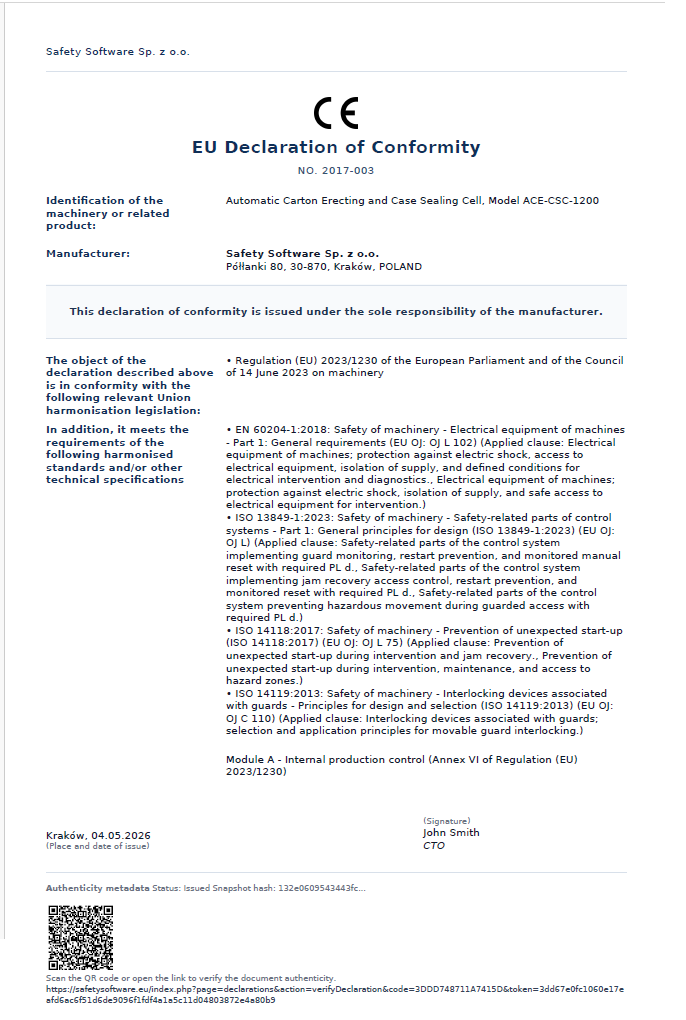
The sample PDF below shows how a new EU Declaration of Conformity can be organised in SafetySoftware: machine identification, manufacturer data, legal basis, standards, conformity assessment procedure, notified body section, document status and signature.
It is not a magic template that makes the machine compliant. SafetySoftware does not grant CE marking. It does not replace risk assessment. It does not take responsibility away from the manufacturer.
What it can do is organise the process the manufacturer must complete anyway before signing the EU Declaration of Conformity.
Because a good declaration does not start in Word. It starts with technical decisions that can be defended later.